Selecting a Rigid Flex Board manufacturer involves more than comparing prices or browsing a polished capability chart. These boards combine flexible circuits with rigid sections, so material choices, layer transitions, and bend design must work together. A small crease near a connector can matter. So can a via placed too close to a flex area. Small details matter.
This 2026 guide is designed to help global buyers assess manufacturers against practical requirements. Look for clear engineering support, documented quality controls, and experience with products similar to yours. Ask how the supplier manages stack-up reviews, controlled impedance, coverlay openings, and bend-radius constraints. Request sample build records or inspection data where appropriate. Useful evidence beats broad claims.
A supplier’s capacity also needs context. Confirm that prototype support, production volumes, lead times, and shipping arrangements match your project—not just a general company profile. Check current certificates and their scope rather than relying on a logo alone. The best fit depends on application, risk, and total cost. There is no universal winner.
This list can narrow the field, but it cannot replace technical review. Share drawings, expected volumes, operating conditions, and acceptance criteria before requesting quotations. Compare responses carefully, including what each supplier flags as a design risk. Some requirements may change after review. That is not necessarily a failure; it may reveal an assumption worth revisiting before production begins.
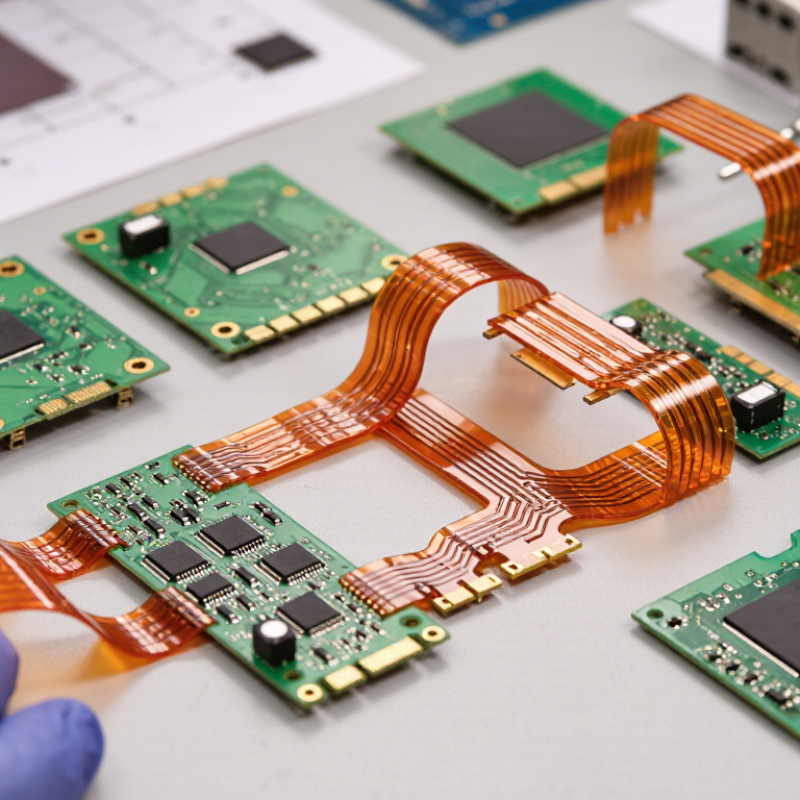
A rigid-flex board combines rigid circuit sections with flexible polyimide layers in one connected assembly. Copper traces continue through the transition, replacing separate cables and connectors. In a compact device, this can mean a small board folding around a metal frame, with components mounted on rigid areas and a bend kept clear. The flexible section is not simply a thinner rigid board. Its copper, adhesive, coverlay, and layer arrangement all affect how it bends and survives.
Bend design matters. IPC-2223 guidance commonly uses minimum bend-radius rules around six times the circuit thickness for static bends and twenty times for repeated flexing; the actual limit depends on stack-up and application. A tight fold can crack copper over time. That sounds simple. It isn’t. Prismark’s 2024 PCB industry review estimated the wider global PCB market at about US$73.6 billion, but that figure covers many board types, not rigid-flex alone. It provides useful context, not a rigid-flex market share. Engineers should confirm bend radius, copper type, and expected movement with fabrication specialists before freezing the layout. Even careful calculations can miss assembly strain.
In 2026, evaluating a rigid-flex manufacturer starts with the actual design, not a polished capability sheet. Share the bend radius, layer count, copper weights, and expected service environment. Ask whether the proposed stack-up suits both the static and dynamic sections. Numbers need context. A stated bend-cycle rating matters only when test conditions resemble your application.
Review evidence for process control and consistency. Request sample inspection reports, impedance results where relevant, material traceability, and records showing how defects are handled. Ask how engineers check clearances around the flex-to-rigid transition and protect exposed copper. A small prototype can reveal a sharp crease or assembly strain that drawings missed. Run a pilot. It is useful, but not perfect.
Compare communication and production readiness alongside technical skill. Can the team explain design trade-offs, flag risks early, and provide realistic lead times? Verify that any quality certifications cover the facility and processes involved, rather than relying on a logo or certificate alone. Also discuss engineering-change control and lot-level documentation before placing an order. A tidy checklist cannot predict every assembly surprise; that limitation deserves attention. The strongest evaluation combines documented capability with practical samples and candid technical discussions.
Choosing a rigid-flex manufacturer is not just about comparing quoted prices. Buyers should examine layer-stack expertise, controlled-impedance capability, material traceability, and inspection records. Prismark’s 2023 industry review estimated global PCB production at about US$69.5 billion, following a market contraction. That broader market figure does not measure rigid-flex alone, but it highlights why buyers should verify capacity and delivery assumptions rather than rely on a sales forecast. For a compact medical instrument or a camera module, ask how the supplier controls bend radius, copper thickness, and coverlay alignment. Small process differences can affect assembly yield.
Strong suppliers provide design-for-manufacturing feedback before tooling begins. They should review bend zones, stiffener placement, via locations, and test access against the intended assembly process. IPC-2223 offers design guidance for flexible and rigid-flex printed boards; buyers can use it as a shared reference during technical reviews. Still, a standard cannot replace project-specific validation. Request cross-sections, electrical test criteria, and sample data from comparable builds. Some teams skip early bend testing to save time. That shortcut can become expensive.
Tips: Send a complete stack-up and realistic annual volume with the first inquiry. Ask for documented material substitutions, first-article inspection results, and a clear plan for engineering changes. Compare the evidence, not only the quoted lead time.
Rigid-flex sourcing depends on more than quoted price or advertised capacity. Compare suppliers by layer count, minimum bend radius, via structures, and experience with dynamic flexing. A useful review includes controlled-impedance data, material options, and sample panels built to a comparable stack-up. Ask for cross-sections and test results. Small details count.
Certifications can indicate disciplined processes, but their scope matters. Check current certificates, covered sites, and whether the supplier’s quality system fits your industry. Relevant standards may include IPC-6013 for rigid-flex qualification, alongside applicable quality-management certifications. Paperwork is not proof. Request anonymized inspection records, first-article reports, and examples of how defects were contained. A scoring sheet helps, but it is imperfect; engineering responsiveness can change after launch.
Regional differences affect lead times, communication, and logistics. Suppliers in East Asia may offer established electronics supply chains, while North American or European partners may simplify collaboration for nearby design teams. These are tendencies, not guarantees. Compare prototype turnaround, production capacity, shipping routes, and local engineering support directly. Ask who handles design-for-manufacturing reviews, and how quickly they respond to a revised bend line or connector location. A clear comparison should weigh verified capability against the needs of your product and production schedule.
Choosing a rigid-flex manufacturer starts with the stackup, not the sales pitch. Share your bend profile, minimum bend radius, layer count, copper weights, impedance targets, and expected annual volume. Ask for a proposed cross-section and design-for-manufacturing review before tooling. IPC-6013 defines qualification and performance requirements for flexible and rigid-flex printed boards; use its applicable class as a clear acceptance baseline. Then check whether the factory can document material substitutions, impedance control, and inspection criteria. Details matter.
Capacity matters, but so does repeatability. WSTS’s Autumn 2024 Semiconductor Market Forecast projected 2024 semiconductor sales at about US$627 billion, up 19% year over year. That forecast signals a fast-moving electronics supply chain, not a guarantee of rigid-flex demand or supplier quality. Ask manufacturers for recent delivery and defect data tied to comparable board designs. Request a sample inspection package, including microsection images, electrical test results, and material traceability. For a high-flex design, confirm that test coupons and bend testing reflect the actual layer build. A glossy prototype can still hide a weak process. I would also ask what happens when a material goes out of stock; the answer may expose gaps in change control. Compare quotations only after scope, test coverage, and acceptance limits match.
WhatsAppOffer Electronics Manufacturing All-in-One
PCBONLINE® is a registered trademark or service mark of pcb online limited or its affiliates.
Copyright © 2001-2024 Pcb Online Limited. All rights reserved