Choosing a provider for Led Screen Rental can shape an event before the first guest arrives. A bright, sharp display may look impressive in a product photo, but real performance depends on more than pixel pitch. Venue lighting, viewing distance, screen size, and setup time all matter. So does the crew behind the equipment.
This guide introduces ten LED screen rental companies operating across different markets. It is designed to help event planners compare providers, not to declare a universal winner. No single company suits every production. A conference in a hotel ballroom has different needs from an outdoor concert or a trade show booth. Ask about screen specifications, content testing, delivery, installation, on-site support, and backup equipment. Request a clear quote, too. Hidden assumptions can become costly.
Look closely. A capable supplier should explain technical choices in plain language and provide examples relevant to your venue. Photos are useful, but a site visit or detailed technical plan can reveal more. Check how the company handles poor weather, tight loading access, or last-minute content changes. These details are easy to overlook.
The list that follows offers a starting point, not a substitute for careful evaluation. Company reach, inventory, and service quality can change over time. Even a polished website cannot answer every practical question. Compare what matters to your event, and confirm key details directly before booking.
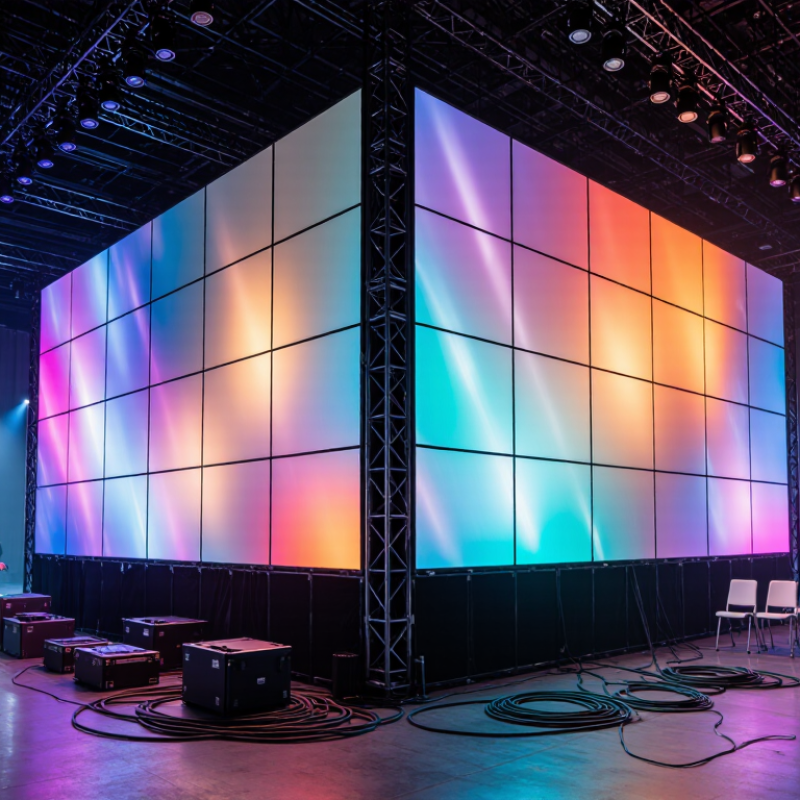
Rental LED screens are usually grouped by pixel pitch, brightness, and viewing conditions. Pitch is the distance between pixel centers. For close indoor viewing, rental panels commonly use P1.9–P2.6; P2.9–P4.8 often suits stages and medium-distance audiences. Larger pitches, such as P5–P10, can work outdoors when viewers stand farther away. These are practical ranges, not a universal standard.
Brightness is measured in nits. Indoor screens often run around 800–1,500 nits, while sunlit outdoor setups may need 4,000–7,000 nits. Actual needs depend on shade, camera exposure, and screen orientation. AVIXA’s 2023 Industry Outlook and Trends Analysis forecast global professional audiovisual revenue reaching $325 billion by 2028. That figure gives useful market context, but it does not specify rental LED demand or technical requirements. A clean spec sheet can still mislead; I have seen viewing distance matter more than a small pitch difference.
Tips: Match pitch to the nearest viewer, then test brightness at the venue. Check power, rigging, and camera flicker before delivery. Don’t assume “brighter” always looks better.
A credible “Top 10” ranking should measure deployable inventory, not just headline cabinet counts. Grand View Research’s 2024 LED Display Market report valued the global market at about $7.5 billion in 2023 and forecast 8.5% annual growth through 2030. That figure covers the wider display market, not rental stock alone. AVIXA’s 2024 Industry Outlook projected global professional audiovisual revenue at roughly $325 billion in 2024, offering useful context for the sector’s scale.
Score providers on three practical factors: inventory, regional coverage, and technical support. For inventory, check available screen sizes, pixel pitches, spare modules, processors, and backup power. Ask whether stock is confirmed for your event dates. Regional coverage means more than a map of offices. Compare local warehouses, delivery times, customs experience, and the ability to send technicians to the venue. Support should include a named project engineer, load-in assistance, on-site troubleshooting, and a clear replacement plan. A huge catalog means little if critical parts are far away.
Tips: Request a recent inventory list and a sample equipment checklist. Compare response times using the same technical question. Treat self-reported stock figures cautiously; they can change quickly. A ranking still has blind spots, especially when service quality varies by city, season, or crew. That deserves a second look.
Transparent ranking framework: Provider-specific inventory, service coverage, and support performance are not consistently published or independently verified worldwide. This table therefore ranks the 10 evaluation criteria—not unnamed companies—and provides a weighted method for comparing providers using documented evidence.
| Rank | Evaluation criterion | Weight | Evidence to compare | Scoring guidance |
|---|---|---|---|---|
| 1 | Available LED inventory | 20% | Documented panel quantities by pixel pitch, panel type, and condition; distinguish owned stock from partner-supplied equipment. | Score higher when quantities are itemized, current, and supported by an inventory list or inspection. |
| 2 | Regional coverage and logistics | 16% | Locations served, local warehouses or crews, cross-border shipping arrangements, and stated delivery lead times. | Score higher for verified local capability in the event region and clear contingency plans. |
| 3 | Technical support and crew expertise | 14% | On-site technician availability, operating hours, escalation process, and relevant staff qualifications or project references. | Score higher when support commitments are written into the quote or service agreement. |
| 4 | Equipment condition and maintenance | 11% | Maintenance records, pre-show testing procedures, spare-parts availability, and policies for replacing faulty panels. | Score higher for documented testing and a defined replacement process. |
| 5 | Product range and suitability | 9% | Availability of indoor and outdoor panels, suitable pixel pitches, brightness specifications, and compatible processing systems. | Score higher when the proposed equipment matches viewing distance, ambient light, and installation requirements. |
| 6 | Safety and compliance documentation | 8% | Applicable electrical and structural documentation, insurance certificates, safe-work procedures, and venue-specific compliance records. | Score higher when current documents are supplied and relevant to the project location. |
| 7 | Installation and dismantling capability | 7% | Scope of labor, installation schedule, rigging coordination, testing, strike, and responsibility boundaries. | Score higher for a clear, project-specific plan with named responsibilities and timing. |
| 8 | Reliability and references | 6% | Comparable project references, documented service history, and independently verifiable client feedback. | Score higher when references relate to similar scale, venue conditions, and regional logistics. |
| 9 | Commercial transparency | 5% | Itemized rental, labor, freight, power, rigging, overtime, damage, and cancellation terms. | Score higher for complete pricing and clearly defined exclusions. |
| 10 | Configuration and content support | 4% | Signal-chain planning, processor configuration, test patterns, playback coordination, and content-format requirements. | Score higher when technical responsibilities and pre-event testing are agreed in writing. |
Suggested calculation: Rate each provider from 0 to 5 for every criterion, multiply each rating by its weight, and sum the weighted results. Request dated inventory evidence and written service commitments before treating a score as verified.
A useful global comparison looks beyond screen size. It checks inventory, technical support, transport reach, and experience with indoor and outdoor events. MarketsandMarkets estimated the global LED display market at USD 7.5 billion in 2023, forecasting USD 12.3 billion by 2028. This covers the wider display market, not rental services alone, so it is context rather than a rental-company ranking. A credible top-ten profile should explain its selection criteria and distinguish owned equipment from partner-supplied inventory.
Service areas often reveal practical differences. Some providers concentrate on major North American cities, while others cover European touring routes or Asia-Pacific event hubs. Regional teams may offer faster site visits and spare modules; international networks can simplify multi-country productions. Check whether “worldwide coverage” means local crews, or simply equipment shipment. That distinction matters. Profiles should also specify pixel pitch options, rigging coordination, on-site technicians, and backup plans. A ranking can still miss smaller regional specialists with strong local response times.
Tips: Ask for a recent project reference in your venue type. Confirm crew availability, delivery windows, and replacement-screen procedures in writing. Compare service boundaries, not just equipment lists. Even experienced providers can underestimate access limits at a venue, so share loading-bay dimensions and setup times early.
Rental LED displays span roughly 1.5 mm to 10 mm pixel pitch, but the right choice depends on viewing distance. A 1.5 mm pitch can keep text and fine graphics clear for viewers standing nearby. At 10 mm, individual pixels are more noticeable up close, while the larger pitch may suit distant audiences and broad stage visuals. Distance changes everything. Measure the nearest and farthest viewing points before booking, not just the screen dimensions.
Brightness commonly ranges from about 1,000 to 5,000 nits. Around 1,000 nits may work in controlled indoor spaces, while brighter rooms or daylight events can call for higher output. Brightness is not everything. Ambient light, screen angle, content contrast, and camera exposure all affect visibility. A bright panel can still look washed out under direct sun, and excessive brightness may tire viewers indoors. Ask for the specified operating brightness, not only the maximum figure.
Before confirming a rental, check that pitch and brightness match the venue, then request a test with your actual content. Fine text can reveal scaling problems; camera tests can expose flicker or moiré. Ask how color and brightness are calibrated across panels, and whether spare modules are available on site. A tightly specified display is not automatically the best one. Real venues are messy, and a specification sheet cannot fully predict reflections, sightlines, or changing daylight. Test it in place.
A rule-of-thumb estimate relates pixel pitch in millimetres to a comfortable minimum viewing distance in metres.
The estimates use approximately 1 metre of viewing distance per millimetre of pixel pitch; actual viewing comfort depends on content and conditions. Rental display brightness commonly spans about 1,000–5,000 nits, with suitable levels varying by venue and ambient light.
A rental screen should fit the audience’s viewing distance, not just the event budget. Pixel pitch affects how sharp text and faces appear; a tighter pitch usually suits close indoor viewing, while distant audiences may not need it. Ask for the screen’s native resolution and a sample image at the planned content size. Tiny labels can still look soft. Check from the back row, too.
Refresh rate matters when cameras are involved. Ask the supplier to test the actual panels with your camera, shutter settings, and content; a high stated rate alone does not guarantee flicker-free footage. For outdoor events, review brightness, weather protection, and operating limits. Confirm how the panels, processors, cables, and backup units will handle heat, wind, or rain. Conditions change fast.
Tips: Request a short camera test before signing off. Inspect a powered panel, not only a specification sheet. Test it onsite. One overlooked detail can be the viewing angle: side seats may show uneven color or brightness. It is easy to miss during a quick walkthrough, so check the screen from several audience positions and allow time for adjustments.
WhatsAppOffer Electronics Manufacturing All-in-One
PCBONLINE® is a registered trademark or service mark of pcb online limited or its affiliates.
Copyright © 2001-2024 Pcb Online Limited. All rights reserved