10 Best Polarization-Maintaining Fiber Manufacturers?
Polarization-Maintaining Fiber has become essential where signal stability matters more than simple transmission. It preserves a controlled polarization state through demanding optical paths. This capability supports fiber-optic gyroscopes, coherent communication, interferometers, and precision sensing.
Industry reports show why the market deserves careful comparison. MarketsandMarkets forecasts continued growth across the global fiber-optics sector, driven by data centers, telecommunications, and sensing systems. Reports from Grand View Research also identify aerospace, defense, and medical instrumentation as important application areas. However, these reports often combine standard, polarization-maintaining, and specialty fibers. That classification can blur the real market picture.
Performance is visible in the details. A laboratory engineer may inspect extinction ratio, beat length, insertion loss, coating quality, and temperature stability. A manufacturer’s reputation matters, but so does consistency between batches. Small variations can affect a gyroscope’s drift or a coherent receiver’s accuracy.
As fiber-optics pioneer Professor David N. Payne has emphasized, optical-fiber progress depends on matching fiber design to the application. That principle guides this ranking of the 10 Best Polarization-Maintaining Fiber Manufacturers. The review considers product range, technical documentation, manufacturing experience, customization support, and independent credibility.
Not every supplier publishes comparable test data. That is a weakness.
Therefore, the list should not be treated as a universal verdict. Buyers still need application-specific testing, lifecycle evidence, and transparent technical discussions. A strong supplier can provide more than a specification sheet. It should explain how the fiber behaves inside the customer’s actual system.
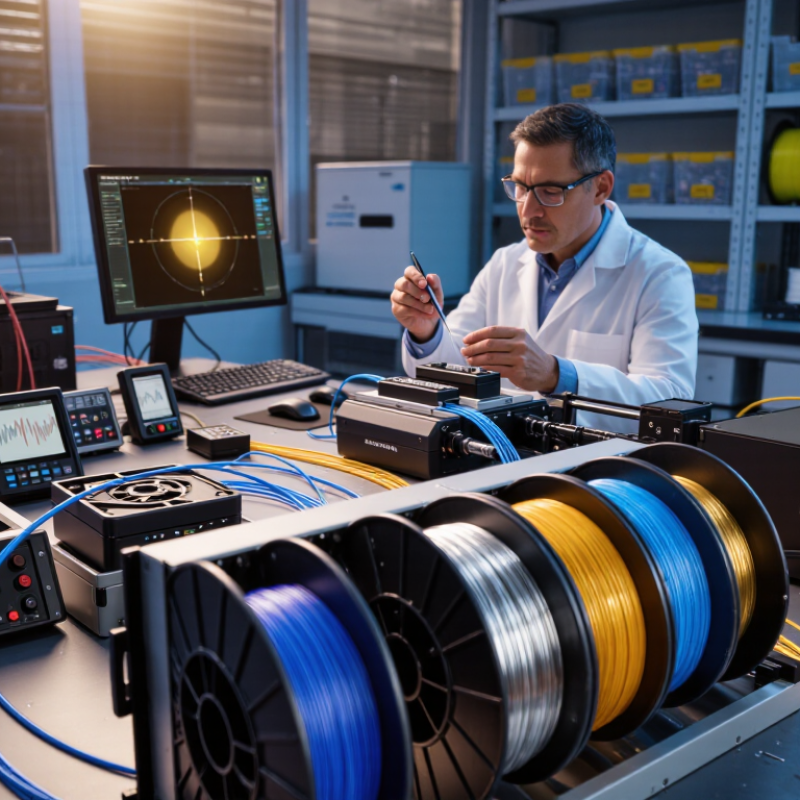
What Is Polarization-Maintaining Fiber?
Polarization-maintaining fiber is an optical fiber designed to preserve a fixed light polarization during transmission. Unlike standard single-mode fiber, it contains a built-in stress pattern or special core geometry. This structure creates two stable polarization axes. Light entering the correct axis stays relatively stable through the fiber. That behavior supports interferometers, fiber sensors, gyroscopes, and precision communication systems.
“Maintaining” does not mean perfect. Bending, twisting, connector pressure, and temperature changes can still disturb polarization. In practical installation, engineers examine beat length, extinction ratio, insertion loss, and alignment tolerance. A shorter beat length often indicates stronger polarization control. However, performance can decline when splicing is careless. Even a small angular error may reduce extinction ratio. This is easy to underestimate.
Tips: Mark the slow axis before cutting or splicing. Keep bend diameters above the supplier’s recommended limit. Avoid tight loops near connectors. Clean end faces before inspection. Test polarization extinction after installation, not only before it. A microscope and a proper power meter can reveal problems early. Some specifications look impressive on paper, yet real performance depends heavily on handling. That part deserves more attention.
What Is Polarization-Maintaining Fiber?
Polarization-maintaining (PM) fiber is an optical fiber designed to preserve the polarization state of light by introducing strong, controlled birefringence. The chart shows the standardized optical communication wavelength bands in which PM-fiber variants may be engineered for sensing, interferometry, lasers, and high-speed optical systems.
The wavelength boundaries follow commonly used ITU-T optical bands: O-band (1260–1360 nm), E-band (1360–1460 nm), S-band (1460–1530 nm), C-band (1530–1565 nm), and L-band (1565–1625 nm). Actual PM-fiber operating ranges depend on fiber design, coating, attenuation, birefringence, and the application.
How to Evaluate Polarization-Maintaining Fiber Manufacturers
How to Evaluate Polarization-Maintaining Fiber Manufacturers
When evaluating polarization-maintaining fiber manufacturers, begin with measurable performance rather than marketing language. Ask for polarization extinction ratio, beat length, attenuation, mode-field diameter, and operating wavelengths. A datasheet alone is insufficient. Request test conditions, tolerance ranges, and recent batch records. These details reveal whether performance is consistent or merely idealized.
Examine the manufacturer’s process expertise and quality controls. Confirm whether fibers receive proof testing, coating inspection, geometry checks, and environmental qualification. Ask how suppliers control tension during drawing, since small variations can affect polarization stability. Review calibration records for testing equipment. Traceability matters. Each spool should connect to a production lot, inspection report, and material history. Vague answers deserve caution.
Practical support is equally important. Can the engineering team recommend a fiber for gyroscopes, interferometers, sensors, or high-power delivery? Do they provide samples with realistic specifications? Ask about connectorization, splicing behavior, storage limits, and custom lengths. Fast answers help, but technically precise answers matter more. A polished website is not evidence. A trial order can expose weak documentation, uneven coating, or unstable extinction ratios. Record these findings before making a larger commitment. Even experienced buyers can overvalue a low price and overlook replacement delays, packaging damage, or limited technical support.
Top Polarization-Maintaining Fiber Manufacturers by Product Strengths
Choosing the 10 best polarization-maintaining fiber manufacturers requires more than comparing catalog prices. Product strength depends on extinction ratio, attenuation, coating stability, and delivery consistency.
Manufacturers serving interferometers often emphasize high birefringence and extinction ratios above 25 dB. These figures support cleaner phase measurements and more stable gyroscope signals. For telecom and sensing systems, low attenuation near the 1310 nm and 1550 nm windows remains important. The 2024 MarketsandMarkets fiber optics report projects strong growth in optical components through 2029, driven by data centers, sensing, and communications infrastructure. That demand rewards manufacturers with scalable preform production and repeatable draw control.
Other suppliers compete through specialty designs. Polarization-maintaining photonic crystal fiber can offer larger mode areas and improved power handling. Compact bend-resistant designs suit crowded instruments, but bending can still reduce polarization performance. It needs testing. Manufacturers with in-house interferometric testing, environmental cycling, and connector qualification usually provide stronger engineering support. A 2024 Grand View Research assessment also identifies sensing and fiber-based medical technologies as expanding application areas, increasing demand for traceable specifications.
A practical ranking should examine test certificates, lot-to-lot data, and sample performance. Not every impressive datasheet reflects field behavior. Humidity, vibration, and tight routing can expose weaknesses quickly. The best manufacturers combine stable products, application engineering, and honest tolerance reporting. A perfect ranking is impossible. Buyer priorities still decide the winner.
10 Best Polarization-Maintaining Fiber Manufacturers? - Top Polarization-Maintaining Fiber Manufacturers by Product Strengths
| Rank | Manufacturer Profile | Primary Product Strength | Fiber Design | Common Operating Band | Typical Extinction-Ratio Target | Typical Application | Selection Advantage |
| 1 | Manufacturer Profile 01 | High-birefringence sensing fiber | Panda-style stress-applying parts | 1,030–1,550 nm | ≥20 dB | Fiber-optic gyroscopes and interferometric sensors | Strong polarization stability for precision sensing |
| 2 | Manufacturer Profile 02 | Telecom-grade polarization control | Panda-style PM fiber | 1,310–1,550 nm | ≥18 dB | Coherent communications and polarization-diverse systems | Broad compatibility with standard communication windows |
| 3 | Manufacturer Profile 03 | 980 nm and 1,060 nm laser delivery | Bow-tie or panda-style PM fiber | 980–1,080 nm | ≥20 dB | Fiber lasers, amplifiers, and medical laser systems | Suitable for common ytterbium and erbium pump architectures |
| 4 | Manufacturer Profile 04 | Polarization-maintaining amplifier fiber | Large-mode-area PM design | 1,030–1,100 nm | ≥17 dB | High-power fiber amplifiers and industrial lasers | Improved nonlinear-effect and power-handling performance |
| 5 | Manufacturer Profile 05 | Polarization-maintaining photonic-crystal fiber | Microstructured PM fiber | Visible–1,550 nm | Application-dependent | Supercontinuum sources and nonlinear optics | Flexible dispersion and nonlinear-response engineering |
| 6 | Manufacturer Profile 06 | Visible-wavelength PM transmission | Bow-tie PM fiber | 450–700 nm | ≥18 dB | Biomedical instruments and visible-light interferometers | Optimized for visible-spectrum polarization management |
| 7 | Manufacturer Profile 07 | Low-loss PM transmission fiber | Panda-style PM fiber | 1,310–1,625 nm | ≥19 dB | Fiber-optic links, sensors, and optical assemblies | Balances attenuation, bend performance, and polarization stability |
| 8 | Manufacturer Profile 08 | PM fiber for fiber-optic gyroscopes | High-birefringence bow-tie design | 1,500–1,600 nm | ≥22 dB | Navigation-grade inertial measurement units | High polarization extinction for demanding interferometric designs |
| 9 | Manufacturer Profile 09 | Specialty PM fiber and custom geometry | Custom stress-applying or elliptical-core design | Application-specific | Application-specific | Research instruments and OEM optical modules | Greater design flexibility for non-standard requirements |
| 10 | Manufacturer Profile 10 | PM fiber assemblies and deployment support | Standard PM fiber with connectorized options | 980–1,550 nm | ≥18 dB | Test equipment, optical modules, and laboratory systems | Convenient integration through pre-terminated and packaged formats |
Note: Operating bands and extinction-ratio values are representative specification ranges commonly used for polarization-maintaining fiber categories. Actual performance depends on fiber construction, wavelength, coating, cabling, connectorization, and the manufacturer’s test method.
How to Select the Best Manufacturer for Your Requirements
How to Select the Best Polarization-Maintaining Fiber Manufacturer
Choosing a polarization-maintaining fiber manufacturer requires more than comparing prices. Ask for measured extinction ratio, polarization crosstalk, beat length, attenuation, and coating performance. IEC 60793-1-60 identifies beat length and polarization characteristics as important test parameters. ITU-T G.650.1 expresses polarization-mode dispersion in ps/√km. These standards help buyers compare results consistently. Request data at your actual wavelength, not only at 1,550 nm.
Manufacturing experience matters when tolerances are tight. Examine process-control records, batch-to-batch variation, calibration schedules, and material traceability. A reliable supplier should provide sample reels, test methods, and a clear failure-handling process. Check whether the factory can support your required core size, coating diameter, proof-test level, and connector design. Delivery history also matters. A perfect prototype is not enough.
Tips: Start with a small qualification order. Test fibers under temperature cycling, bending, vibration, and long-duration transmission. Compare the supplier’s results with an independent laboratory. Ask how many production batches support the quoted specification. Be cautious with unusually attractive pricing; it may reflect limited testing or unstable volume control. I would not trust a polished datasheet alone. In practice, even experienced buyers can overlook packaging stress, reel handling, or connector-induced polarization changes. The best manufacturer is the one that documents these weaknesses and helps correct them.
(Sources: IEC 60793-1-60; ITU-T G.650.1.)


 Phone
 WhatsApp
 Email