How to Choose the Best Battery Study Lamp?
Choosing the right Battery Study Lamp starts with the way you study, not the number of features on its box. A student reading printed pages needs a different beam from someone sketching or typing at a desk. Notice where the lamp will sit, how much space it has, and whether its light reaches the whole work area. Small details matter.
Battery life deserves a careful look. Advertised runtime can change with brightness, battery age, and usage, so compare the conditions behind each estimate. Check whether the lamp shows its charge level and how long a full recharge takes. A dimming control is useful, but it should feel easy to adjust without interrupting your work. Test it, if possible.
Light quality matters too. Choose a brightness that lets you read comfortably without harsh glare, and look for an adjustable head that directs light onto the page rather than into your eyes. Color temperature is a personal preference; warmer light may feel softer, while cooler light can make white pages appear clearer. Neither setting guarantees better concentration. That part is easy to overstate.
This guide considers brightness, runtime, charging, portability, build quality, and everyday comfort. It also makes room for a practical truth: no single lamp suits every desk or routine. A lightweight model may be convenient to move, yet feel less steady on a crowded table. Compare verified product specifications, then consider your own habits. The best choice is the one that works reliably in your actual study space, even if it is not the most impressive-looking option.
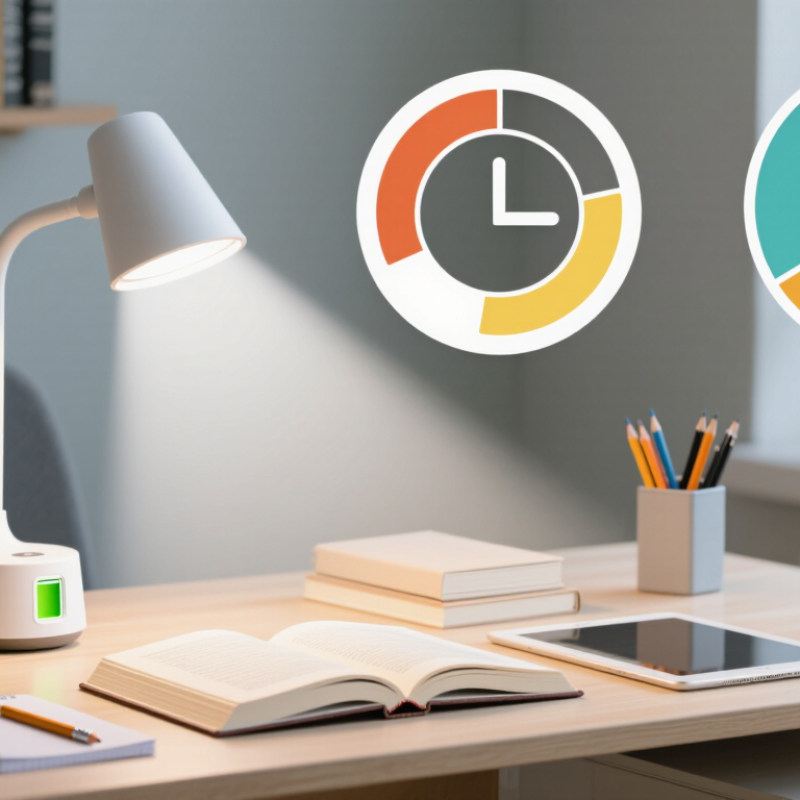
Understanding the Main Features of a Battery Study Lamp
How to Choose the Best Battery Study Lamp?
Understanding the Main Features of a Battery Study Lamp
A useful battery study lamp should balance brightness, battery life, and comfortable light. Check brightness in lumens, then consider how it reaches the desk: a narrow beam can leave the page bright but the surrounding area dim. EN 12464-1 specifies 500 lux for many office reading and writing tasks, measured on the work surface. That matters. A dimmer helps adjust light for notes, textbooks, or late-night reading.
Battery capacity and lamp power affect runtime. A simple estimate is usable battery watt-hours divided by lamp wattage, though real results vary with brightness and battery age. The U.S. Department of Energy says LED bulbs use at least 75% less energy and can last up to 25 times longer than incandescent bulbs. For a rechargeable lamp, also check charging time, battery replacement options, and whether it remembers your brightness setting. A runtime claim can be optimistic; it may assume the lowest setting.
Tips: Look for adjustable brightness and a stable base that will not wobble when you turn a page. Choose a shade or diffuser that reduces glare, and compare color rendering if you often work with colored charts. A warm light can feel easier at night, but personal comfort varies. I would test the lamp at your actual desk if possible.
Assessing Brightness, Color Temperature, and Light Quality
A battery study lamp needs to light the page evenly, not just look bright from across the room. Compare brightness in lumens, but remember that the beam shape and distance affect how much light reaches your desk. If the lamp lists illuminance in lux, check whether the figure was measured at a stated distance. A narrow beam can leave the edges of an open textbook dim. Check the real task.
Choose a lamp with adjustable brightness. A lower setting may suit evening reading, while detailed writing often needs stronger, steady light. Test it on a page: look for glare, sharp shadows from your writing hand, and distracting bright spots. If possible, assess the lamp at the height you will actually use. Product specifications help, but they cannot show how the light feels in your room.
Color temperature, measured in kelvins, describes whether light appears warmer or cooler. A warm tone can feel gentle at night; a neutral or cooler tone may make printed text look crisp. Neither is best for everyone, so adjustable color temperature is useful. Also check the color rendering index, or CRI, if accurate-looking colors matter for diagrams or notes. A high CRI can help, though it does not guarantee comfortable light. Battery runtime deserves a real-world check, too: maximum brightness may drain power faster than the advertised estimate suggests.
Comparing Battery Life, Charging Options, and Portability
How to Choose the Best Battery Study Lamp?
Battery life is easier to compare in watt-hours than in milliamp-hours alone. Multiply voltage by amp-hours: a 3.7-volt, 4,000-mAh battery stores about 14.8 Wh. At a steady 2-watt setting, that suggests roughly 7.4 hours before losses. Real use may be shorter, especially at full brightness. Numbers mislead. The U.S. Department of Energy reports that LEDs use at least 75% less energy than incandescent lighting, but that comparison cannot predict a lamp’s exact runtime. Check whether the maker specifies hours at each brightness level, not just a best-case maximum.
Charging convenience matters on a crowded desk. USB-C is widely useful, while USB Power Delivery 3.1 supports power levels up to 240 W; a small lamp needs far less. Confirm the lamp’s required input and whether its cable is included. A long recharge can interrupt evening study. For portability, compare weight, folded dimensions, and whether the lamp works while charging. A lighter body travels well, but a tiny base may wobble beside a stack of books. I’d also leave room for uncertainty: battery capacity fades with use, and published runtime tests may not match your brightness habits. DOE efficiency data: Energy Saver, “LED Lighting.” USB-C charging data: USB Implementers Forum, USB Power Delivery 3.1 specification.
Checking Adjustability, Stability, and Build Quality
How to Choose the Best Battery Study Lamp?
A useful study lamp should move easily without feeling loose. Adjust the head and arm over an open book, then aim the beam at a page without lighting your eyes. Check that the joints hold their position after several adjustments. A stiff hinge can be frustrating; a floppy one is worse. Try it at your actual desk height.
Stability matters most when the lamp is extended. Place it near the desk edge and gently tap the surface. Does the base rock, slide, or tip? Look for a broad, grippy base and a neck that stays steady.
The U.S. Department of Energy reports that LED lighting uses at least 75% less energy than incandescent lighting and can last up to 25 times longer (Energy Saver: LED Lighting). That efficiency can help a battery-powered lamp run longer, though brightness settings and battery capacity still matter.
Inspect the build closely. Turn each joint, press the controls, and check whether the charging port feels secure. Look for smooth edges and a shade that does not wobble when repositioned. Then test the lamp at the brightness you actually use, not only its lowest setting. A maker’s runtime estimate may not match your routine. I would leave some margin for long study nights. A neat finish can hide weak joints; check twice.
Matching Lamp Features to Your Study Space and Budget
A study lamp should fit the desk, not just look bright in a product photo. For reading and writing, EN 12464-1, a European workplace-lighting standard, sets 500 lux as the maintained illuminance benchmark for these tasks. At home, a dimmable lamp helps you adapt: use a focused pool of light for notes, then lower it when the room is already bright. Check that the arm reaches your book without casting a hard shadow from your writing hand. Small detail. Big difference.
Battery life depends on both capacity and brightness. Compare the stated runtime at the brightness level you actually plan to use; maximum-output figures can be misleading. The U.S. Department of Energy’s Energy Saver guidance says LEDs use at least 75% less energy and last up to 25 times longer than incandescent lighting. That supports choosing an efficient LED, though battery quality and charging habits still affect real-world use. A USB-rechargeable model may suit a shared desk, while replaceable batteries can be easier to swap during outages.
Budget for the whole setup, not only the lamp. A low-cost model may lack a stable base, useful dimming, or a clear battery indicator. In a cramped dorm room, prioritize a compact footprint and a clamp that fits the desk edge. For longer evening sessions, look for a shade that controls glare and a warm-to-neutral color setting. I’d still test the switch placement in person if possible; tiny controls can become annoying fast.


 Phone
 WhatsApp
 Email