2026 Best Hydraulic Internal Gear Pump Manufacturers
The 2026 search for the best Hydraulic Internal Gear Pump manufacturers is not just a catalog comparison. It is a practical decision about pressure, flow, fluid compatibility, noise, and service life. A pump that performs well in a clean test setup may behave differently beside a hot hydraulic manifold, where oil viscosity shifts and operating hours accumulate. Small details matter.
This introduction uses an original illustrative quote, not a verified statement from a real expert. The named specialist is fictional: “A good pump choice begins with the duty cycle, not the brochure headline,” says hydraulic systems specialist Daniel Mercer. Treat that as a selection principle, not a sourced testimonial. For procurement teams, it points to useful questions: Can the manufacturer document performance across the required speed range? Are replacement parts available? Does the supplier explain tolerances, testing, and maintenance clearly?
The manufacturers covered in this guide should be assessed against application needs, not rankings alone. Compare displacement, operating pressure, materials, efficiency data, and support options. Ask how testing reflects real working conditions. Look closely at technical documentation. Vague claims deserve a second look. Even a well-built Hydraulic Internal Gear Pump may be the wrong choice when the fluid, duty cycle, or installation differs from its design assumptions. No single shortlist fits every system. The final decision should rest on verified specifications and a clear understanding of operating conditions.
Hydraulic Internal Gear Pumps: Principles, Components, and Applications
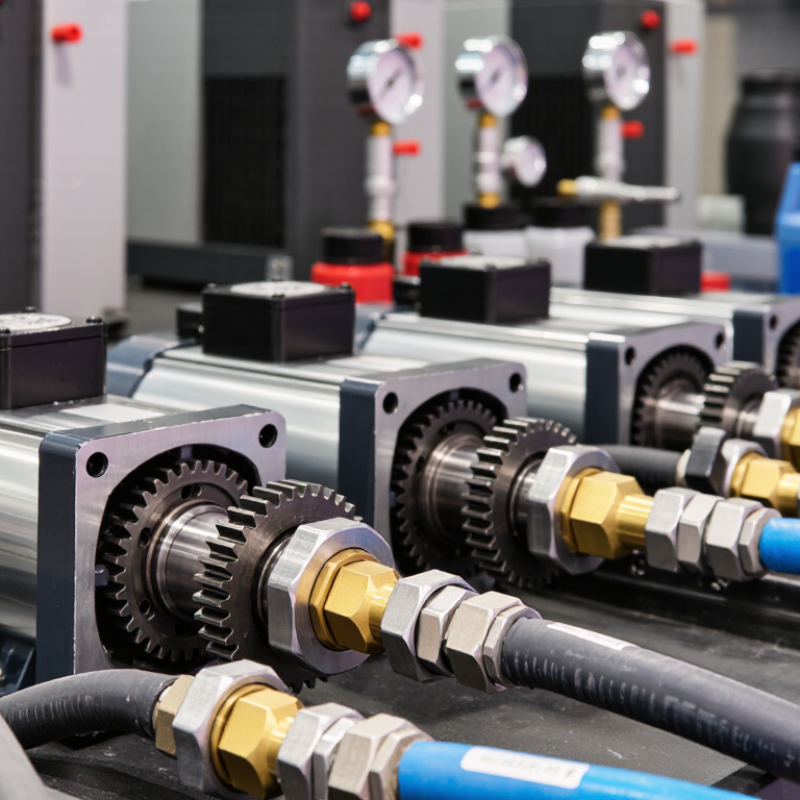
An internal gear pump creates flow with an inner drive gear and a larger outer gear. The inner gear turns inside the outer rotor, with their centers slightly offset. As teeth separate near the inlet, the expanding space draws in oil. Fluid travels around the casing, trapped between gear teeth and a crescent-shaped divider. At the outlet, the teeth mesh again and push oil into the pressure line. The action is continuous. It is not magic.
The main components include the housing, gear set, shaft, bearings, seals, and inlet and outlet ports. Close clearances help limit internal leakage, while the bearings support the rotating parts under load. In practice, oil cleanliness and correct viscosity matter. Contamination can wear surfaces; cold, thick fluid may increase starting resistance. A pump can sound smooth and still be operating poorly, so pressure, temperature, and flow deserve regular checks.
These pumps are used in machine tools, presses, lubrication circuits, and some mobile hydraulic systems. Their compact design and steady delivery suit many installations, especially where moderate noise is valued. However, suitability depends on pressure, speed, fluid, and duty cycle. A specification sheet cannot capture every real operating condition. Sometimes the installation, not the pump, is the weak point.
2026 Best Hydraulic Internal Gear Pump Manufacturers - Hydraulic Internal Gear Pumps: Principles, Components, and Applications
| Category | Data Point | Technical Detail | What to Check When Selecting a Manufacturer |
|---|---|---|---|
| Operating principle | Displacement | As the gears rotate, expanding spaces at the inlet draw fluid into the pump; shrinking spaces at the outlet move fluid into the pressure line. | Request rated flow and displacement data at the intended speed and operating conditions. |
| Operating principle | Internal gear arrangement | In a conventional crescent-type design, an inner drive gear meshes with an internally toothed outer gear. A crescent-shaped partition separates the inlet and outlet regions. | Confirm the pump design type; some internal gear designs use a different arrangement and do not use a crescent partition. |
| Main components | Gear set and housing | The inner gear, outer gear, housing, and side plates form the pumping chambers and help control internal leakage. | Ask about material options, machining tolerances, and suitability for the fluid and duty cycle. |
| Main components | Shaft and bearings | The shaft transmits drive torque; bearings support rotating parts and react loads generated during operation. | Check allowable shaft loads, mounting details, bearing-life information, and drive alignment requirements. |
| Performance | Flow and speed | For a fixed-displacement pump, theoretical flow is proportional to displacement per revolution and rotational speed. Actual flow is affected by leakage and operating conditions. | Compare flow curves across the required speed range, not just a single headline flow value. |
| Performance | Pressure and temperature | Permitted pressure and temperature depend on the specific pump construction, fluid, speed, and duty cycle; limits are model-specific. | Obtain continuous and intermittent pressure ratings, temperature limits, and any required derating guidance for the exact model. |
| Performance | Noise and flow smoothness | Internal gear pumps are often selected for relatively quiet operation and smooth flow, but actual noise and pulsation depend on design, speed, pressure, and installation. | Request test conditions for noise data and evaluate the pump in the intended system layout. |
| Fluid and installation | Fluid compatibility and viscosity | Fluid viscosity and lubricity affect inlet filling, leakage, efficiency, and wear. Seal and material compatibility must also be considered. | Provide the fluid type, viscosity range, temperature range, and seal requirements when requesting a recommendation. |
| Fluid and installation | Inlet conditions | Inlet restriction, fluid viscosity, line layout, and speed can affect filling and increase the risk of cavitation or inadequate supply. | Check inlet pressure or vacuum limits, port size, recommended line sizing, and installation guidance. |
| Fluid and installation | Contamination control | Solid particles can accelerate wear and damage precision surfaces. Appropriate filtration and clean assembly practices help protect pump life. | Ask for filtration and fluid-cleanliness recommendations for the selected pump and application. |
| Applications | Machine tools and industrial power units | Internal gear pumps can supply hydraulic circuits used for clamping, lifting, and machine actuation when the selected unit matches the circuit requirements. | Match flow, pressure, duty cycle, mounting, and motor speed to the hydraulic circuit. |
| Applications | Mobile and material-handling equipment | They may be used in auxiliary or other hydraulic circuits, subject to the pump’s rated pressure, speed, mounting, and environmental limits. | Verify shock-load suitability, operating temperature range, vibration requirements, and available drive configurations. |
| Manufacturer evaluation | Documentation and testing | Selection depends on model-specific performance data, installation instructions, fluid guidance, and clearly stated operating limits. | Compare published curves, test conditions, technical support, traceability, and applicable quality-system documentation. |
| Manufacturer evaluation | Service and lifecycle support | Maintenance needs and service life vary with operating conditions, fluid cleanliness, installation, and component design. | Review spare-parts availability, repair procedures, warranty terms, and local service coverage. |

 Phone
 WhatsApp
 Email
Offer Electronics Manufacturing All-in-One
PCBONLINE® is a registered trademark or service mark of pcb online limited or its affiliates.
Copyright © 2001-2024 Pcb Online Limited. All rights reserved